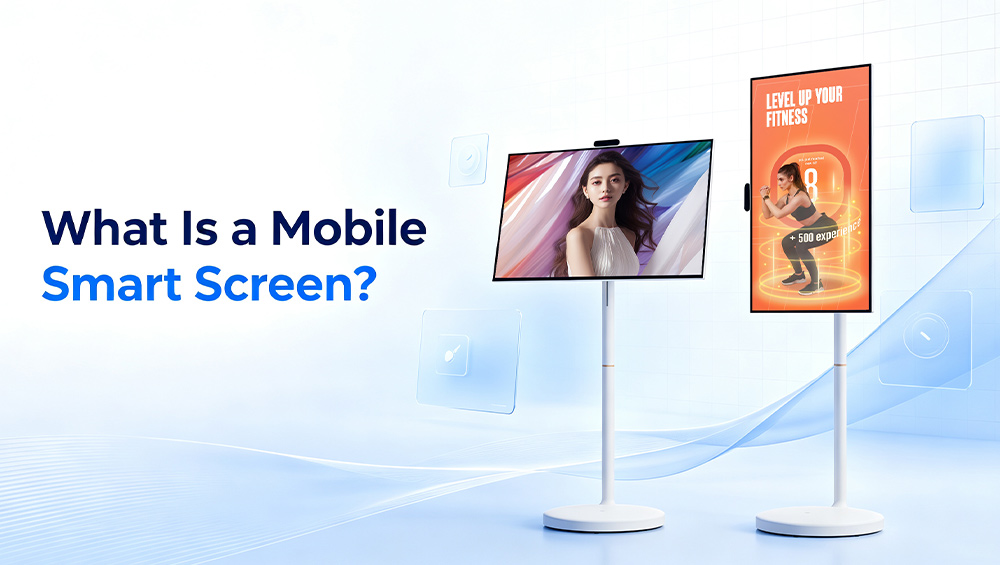
If you follow consumer-electronics trends out of Shenzhen, you have seen them: large touchscreens on wheeled stands, rolled from a living room to a kitchen to a home gym, running Android apps with no power cord in sight. In China this category has a nickname meaning "follow-your-heart screen". In North America it is sold as a mobile smart screen, portable smart display, or rolling smart TV — and it has become one of the fastest-growing display categories importers are asking about.
What exactly is a mobile smart screen?
A mobile smart screen combines five things in one product:
- A touch display, typically 27″ or 32″ — big enough for group viewing, small enough to move through doorways.
- A built-in battery, commonly around 10,000 mAh, delivering roughly 5 hours of typical cordless use — enough for a workout session, a pop-up event shift, or an evening of streaming.
- A rolling stand with a weighted base, silent casters and height adjustment, so one person can move and reposition it without tools.
- A full smart TV operating system — Android with Wi-Fi, Bluetooth, speakers and app support. On certified models this includes Google EDLA, meaning the official Play Store, YouTube, Google Meet and other Google apps run natively.
- Wireless mirroring from phones and laptops — iOS (AirPlay) and Android screen casting built in — so any content on a phone is one tap from the big screen.
Think of it as a giant tablet on wheels, or a smart TV that finally escaped the wall.
Who is buying them, and for what?
Retail pop-ups and showrooms. A battery-powered screen needs no electrician and no venue approval for cabling. Retailers roll it to the storefront for a morning promotion, then back inside for product demos. Branded content plays from the built-in Android player or a mirrored phone.
Gyms and home fitness. This is the breakout use case. A 27″ or 32″ screen at eye level, playing follow-along workouts from YouTube or a fitness app, then rolled away after class. Studios use several as portable class signage; home users treat it as a workout companion that also does movie night.
Hospitality and events. Hotels use mobile smart screens as movable concierge displays, event signage, and in-room entertainment upgrades without rewiring. Conference venues rent them as breakout-room displays.
Offices and classrooms. Small meeting rooms get a shareable touch display with no installation; teachers roll one screen between rooms instead of equipping every classroom.
Why importers like the category
Three structural reasons. First, the ticket size is attractive: it is a consumer-feeling product with a commercial-grade margin, sitting between a TV and a digital signage kiosk in price. Second, the logistics are friendly: a 27″–32″ unit ships one-per-carton by sea or even air, unlike 86″ panels that need project freight. Third, the category is still early in North America — search interest and social-media exposure are climbing while shelf competition remains thin, which is exactly when distributors want to establish a brand.
What to check before importing
- Battery certification and shipping class. Lithium batteries mean UN38.3 test reports and correct DG declarations for sea/air freight. Ask for the battery test report up front.
- Google EDLA certification. If you want the Play Store and Google apps, verify EDLA certification rather than accepting "Android with app store" claims — uncertified devices cannot legally ship Google Mobile Services.
- Screen quality at close range. These screens are used at arm's length, so touch response, brightness and anti-glare finish matter more than on a wall-mounted panel.
- Stand stability. A weighted, tip-resistant base with lockable casters is essential for retail and gym floors; ask for tilt-test information.
- After-sales for batteries. Batteries are consumables — confirm replacement pack availability and price for the years ahead.
The bottom line
A mobile smart screen is a battery-powered, rolling Android touch display — part TV, part tablet, part signage player. It solves real problems for retail pop-ups, fitness, hospitality and flexible workspaces, and it is early enough in North America that importers can still build a position.
See the specs of our 27″/32″ mobile smart screens — Google EDLA certified, 10,000 mAh battery, wireless mirroring built in — or ask us for a sample and pricing.