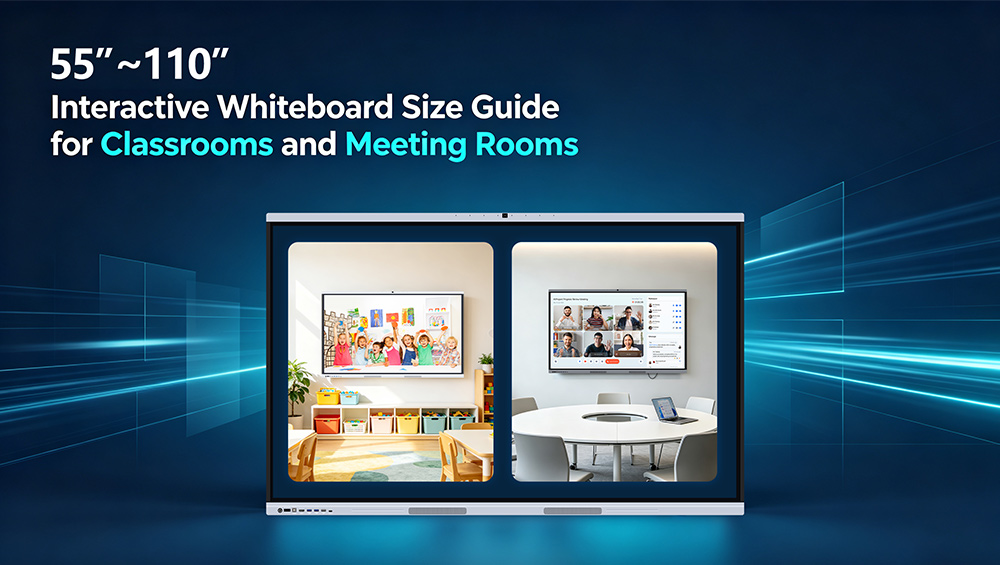
Choosing the wrong interactive whiteboard size is the most common — and most expensive — mistake in classroom and meeting-room projects. Too small, and the back row squints; too large, and you blow the budget on pixels nobody needs. This guide maps each size in a typical 55″–110″ smart board lineup to the rooms it actually fits.
The numbers below are general industry rules of thumb, not absolute standards. Always check your project's own requirements (and any tender specification) before finalizing.
The viewing-distance rule of thumb
A widely used guideline: the farthest viewer should sit no more than about 4–6 times the screen height from the display for comfortable reading of presentation text. For a 75″ 16:9 panel (screen height ≈ 93 cm), that means a maximum viewing distance of roughly 4–5.5 meters. Touch interaction happens at arm's length, so the person presenting always has a good experience — it is the audience at the back you are sizing for.
A second rule of thumb used by AV integrators: the screen width should be at least one-quarter to one-third of the room depth. In a 9-meter-deep classroom, that points to a 86″–98″ class display.
Size-by-size recommendations
55″ — huddle rooms and small offices
Best for 2–6 people in rooms up to about 4 meters deep. Think huddle spaces, small tutoring rooms, and executive offices. A 55″ smart board is also the budget entry point for distributors building a product line.
65″ — small classrooms and standard meeting rooms
The workhorse for rooms of 4–6 meters with 6–15 viewers. Many K-12 classrooms in North America fall into this band, and 65″ is often the volume seller in education tenders for smaller rooms.
75″ — the mainstream classroom and boardroom size
For rooms around 5–7 meters deep with 15–25 viewers. If a district or corporate buyer asks for "one size for most rooms", 75″ is the most common answer — big enough for the back row, small enough to fit standard wall mounts and freight elevators.
86″ — large classrooms and conference rooms
For 7–9 meter rooms with 25–40 viewers. This has become the default for new school builds in many districts, and for corporate conference rooms where content is viewed from a long table. Check door and corridor widths before delivery — an 86″ panel in its flight packaging is large.
98″ — lecture halls and training centers
For rooms 9 meters and deeper, with 40–60 viewers. Also popular as a premium boardroom statement piece. Consider wall load-bearing and reinforced mounting at this size.
110″ — auditoriums and flagship spaces
For very large rooms, auditoriums and showpiece installations where a video wall would otherwise be considered. At 110″, plan logistics early: site survey, lift access, and a professional install crew are essential.
Beyond diagonal size: three things buyers forget
Aspect and resolution. All mainstream interactive flat panels are 16:9, and at 65″ and above you should insist on 4K UHD (3840 × 2160). At typical classroom viewing distances, 4K keeps small text crisp when a teacher shares a full spreadsheet or web page.
Mounting height. Industry guidance typically places the center of the screen near seated or standing eye level — roughly 110–130 cm from the floor for classrooms. A panel mounted too high makes the bottom touch zone unusable for younger students.
Glare and lighting. Size interacts with brightness and glass. Large rooms with windows benefit from anti-glare etched glass, which is standard on quality smart boards, and from keeping the display off the wall opposite large windows.
A quick mapping table for your spec sheet
- Up to 4 m room depth / 2–6 viewers → 55″
- 4–6 m / 6–15 viewers → 65″
- 5–7 m / 15–25 viewers → 75″
- 7–9 m / 25–40 viewers → 86″
- 9 m+ / 40–60 viewers → 98″
- Auditoriums / 60+ viewers → 110″
These mappings are general rules of thumb used across the AV industry; viewing-distance comfort also depends on content type (text vs. video) and room lighting.
Need help sizing a project?
Send us your room dimensions and audience counts — we will map them to the right models in our 55″–110″ interactive flat panel lineup and quote accordingly. For tenders, we can also supply size-specific spec sheets and mechanical drawings: start an RFQ here.