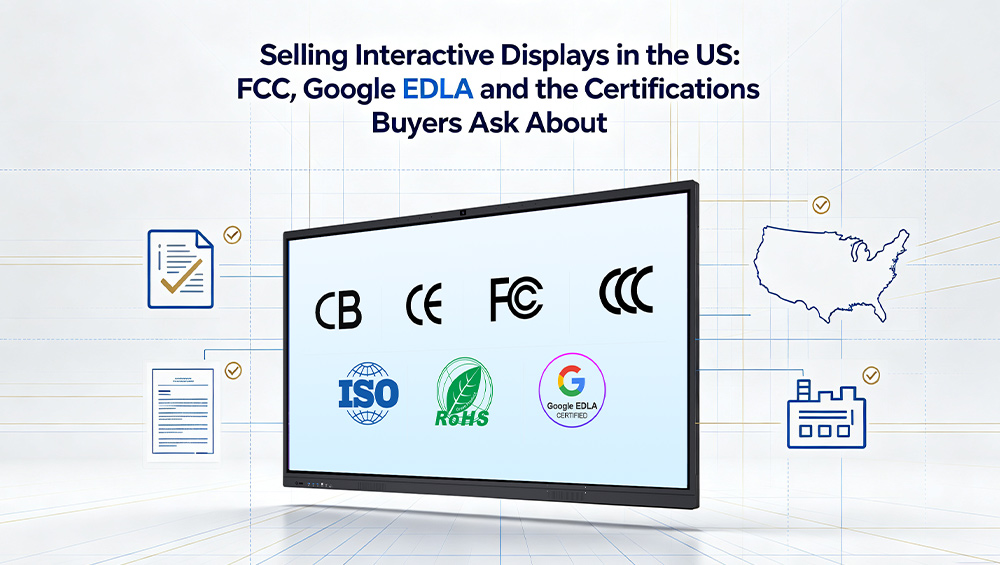
Certifications are the least exciting part of an interactive display purchase — right up until a shipment is held at customs, a school district's legal team rejects your bid, or a buyer asks why your "Android" smart board has no Play Store. This guide explains the certificates North American buyers actually ask about, what each one does, and how to verify them before you wire a deposit.
FCC: the non-negotiable for the US market
The FCC (Federal Communications Commission) regulates electromagnetic interference. Any electronic device sold in the United States must comply with FCC Part 15 rules — for interactive displays this typically means testing as a Class A (commercial) or Class B (residential) digital device. In plain terms: the display must not emit interference that disrupts other electronics, and it must tolerate interference itself.
What to ask your supplier: the FCC test report and certificate for the specific model you are buying, issued by an accredited lab, with the certificate holder matching the factory or your supplier's legal entity. A certificate for "a similar model" is not a certificate for your model.
CE and RoHS: the European pair that still matters in the US
CE marking (EMC and safety directives) and RoHS (restriction of hazardous substances) are European requirements — so why do US buyers ask for them? Two reasons. First, many North American distributors sell into both markets or want the option. Second, CE/RoHS documentation is a quick proxy for whether a factory runs a disciplined compliance process at all. A supplier with clean CE and RoHS files almost always has organized FCC paperwork too.
CB Scheme: one safety test, many countries
The CB Scheme is an international system for mutual recognition of safety test results (IEC standards). A CB test certificate does not itself open any market, but it dramatically simplifies obtaining national safety certifications in member countries later. If you plan to expand beyond the US, a supplier whose products already carry CB certificates saves you months of duplicated lab work.
ISO 9001: about the factory, not the product
ISO 9001 certifies the factory's quality-management system — documented processes for design, production, inspection and after-sales. It is not a product certificate and does not replace one, but enterprise and public-sector procurement teams routinely require it from vendors. Treat it as evidence the factory will build your tenth container the same way it built your sample.
Google EDLA: the one buyers forget until it is too late
EDLA (Enterprise Devices Licensing Agreement) is Google's certification program that allows a device to ship with Google Mobile Services — the Play Store, YouTube, Google Meet, Google Classroom, Google Drive and the rest. Here is the critical point many importers learn late: "runs Android" does not mean "has Google apps". AOSP Android without EDLA has no Play Store and no legal way to add it.
For smart boards sold to US education, EDLA is increasingly a tender requirement because teachers live in Google Classroom. For mobile smart screens sold to consumers, it is the difference between a real smart TV experience and a frustrating sideloading exercise. Always ask: is this specific model EDLA certified, or is EDLA an option? At e-uniwill, for example, our mobile smart TV line is EDLA certified and EDLA is available as an option on smart boards.
An honest word about UL and ETL
You will sometimes see UL or ETL marks requested — these are NRTL (Nationally Recognized Testing Laboratory) safety certifications. Strictly speaking, OSHA NRTL certification is mandatory for workplace equipment, and some enterprise buyers, insurers and specific project specs do request UL/ETL-listed displays. It is fair to say this varies by project: many interactive displays are sold in the US with FCC compliance plus international CB-based safety documentation, while some tenders and corporate standards specifically ask for UL/ETL.
Our advice, honestly: read your target customer's procurement requirements before assuming either way. If a project requires UL/ETL, say so at RFQ stage — the certification path affects product configuration, cost and timeline, and any trustworthy factory will tell you upfront what it can and cannot provide. e-uniwill's current certificate set is CE, FCC, RoHS, ISO 9001, CB and CCC, plus Google EDLA — we will always state clearly what is covered and help you assess what your specific project needs.
How to verify any certificate in five minutes
- Request the full PDF, not a logo image.
- Check the certificate holder name against the factory's business license.
- Check the model number against your quotation.
- Check the issuing lab and, where applicable, verify the report number on the lab's website.
- For EDLA, ask for evidence tied to the specific device model and software build.
The bottom line
For selling interactive displays in the US: FCC is mandatory, CE/RoHS signal a disciplined factory, CB simplifies expansion, ISO 9001 covers the factory itself, and Google EDLA decides whether the product actually delivers the Google experience end users expect. Verify documents by model number, and raise any UL/ETL project requirements at the start — not after production.
Review our certifications and compliance pack, or request certificates with your quotation — we include them by default.